The first time I watched a silver layer fail in production, it failed quietly. No alert, no red job, no phone call. Just a Monday dashboard showing revenue that was three days old. The pipeline had run fine. It had run twice on the same stale file.
That is what weak orchestration costs, and the bill is measurable. Gartner puts the average cost of poor data quality at $12.9 million a year per organization. In mid-market companies, most of that shows up as engineers re-running jobs and executives arguing about whose number is right.
The newer version of that bill arrives through the models. The same stale partitions that embarrass a Monday dashboard are the partitions your forecasting model trains on and your retrieval layer hands to an LLM. AI model data integrity is not a separate program. It is orchestration, observed.
A lakehouse does not fix this on its own. Orchestration does.
Why a Mid-Market Lakehouse Needs Real Orchestration
The lakehouse gives you data lake storage economics with warehouse behavior: ACID transactions, schema enforcement, and one copy of the data serving BI, MLOps, and the retrieval layer behind any generative AI work. That is the foundation. Orchestration is what moves data across it.
Orchestration means scheduling jobs, enforcing the order they run in, checking quality between steps, and telling a named human when a step breaks. Skip it and the lakehouse becomes a swamp: inconsistent loads, silent failures, and stale tables feeding models nobody trusts.
Mid-market teams feel this faster than large enterprises. You have two to ten data engineers, not two hundred. Every hour spent babysitting a pipeline is an hour not spent building a data product someone actually uses.
What Actually Breaks Without Orchestration
We see the same five failures at nearly every client.
- Source sprawl. CRM, ERP, billing, web analytics, and device telemetry each land on their own schedule in their own format. Nothing reconciles them, so two reports show two revenue numbers.
- Brittle scripts. A cron job on somebody’s laptop, or a notebook someone runs by hand. It works until that person takes vacation.
- No observability. When a model degrades, tracing the cause through disconnected jobs takes days. Usually the answer is an upstream schema change nobody announced.
- Scale walls. The job that finished in four minutes on 10 million rows runs six hours on 400 million, and it runs at 3 a.m. against the same cluster as everything else.
- Governance gaps. Without automated lineage, proving GDPR or HIPAA compliance turns into a manual audit every quarter.
The Four Pillars of Lakehouse Orchestration
1. Scheduling and Workload Management
Jobs run at the right time, in the right order, on compute you sized on purpose.
- Time-based triggers. Cron expressions for batch loads that follow a business calendar, including month-end close.
- Event-based triggers. Databricks Auto Loader picks up files as they land in cloud storage. You stop polling directories, and real-time data for AI features arrives without waiting on a nightly batch.
- Compute policy. Job clusters sized per workload, with limits, so one backfill does not starve the morning refresh.
Databricks Workflows handles this natively inside the lakehouse. For most mid-market teams that beats running a separate scheduler you have to patch, secure, and monitor yourself.
2. Dependencies You Can Actually See
- Upstream and downstream order. Gold tables wait for silver. Silver waits for bronze. No manual overrides.
- Conditional execution. The next task runs only after the quality check passes. If row counts drop 40 percent overnight, the pipeline stops instead of publishing.
- Lineage. Unity Catalog records column-level lineage across tables, notebooks, and jobs, so debugging starts with a map instead of a guess.
3. Observability
- Monitoring of job status, runtime, and row counts per run.
- Logging at every step, retained long enough to investigate last month’s incident.
- Alerting to the person who owns the table, not to a channel nobody reads.
- Quality checks at each layer: nulls in key fields, type drift, duplicate keys, freshness windows.
- Model-facing checks that flag drift in a training or feature table, so MLOps orchestration retrains against the data rather than against the calendar.
In our builds, the alert that earns its keep is not “job failed.” It is “job succeeded and the numbers look wrong.”
4. Failure Recovery
- Automated retries with exponential backoff for transient cloud errors.
- Idempotent tasks so a re-run produces the same table, not double-counted rows.
- Explicit error paths. Quarantine the bad records, notify the owner, keep the good data moving.
- Circuit breakers that stop downstream work when an upstream source keeps failing.
Governed and Measured, Not Ad Hoc
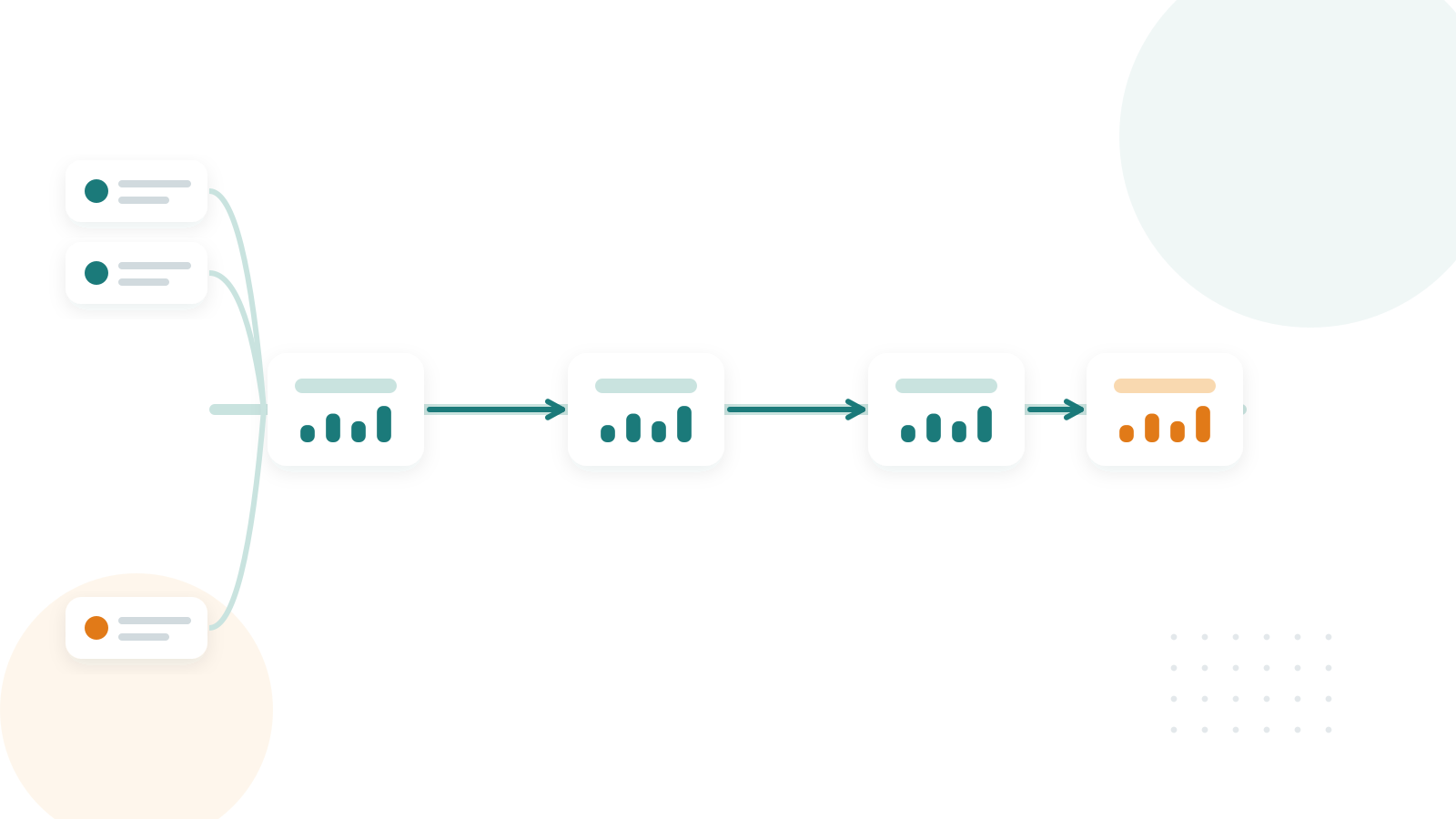
The shift we drive is from a pile of jobs to one governed pipeline with numbers attached to it. Medallion architecture does the structural work: bronze holds raw source data, silver holds cleaned and conformed records, gold holds the business tables that feed dashboards and models.
Unity Catalog does the governance work: one permission model, one audit trail, one lineage graph across every workspace. We apply our AIM-IT Framework on top of that structure: Assess, Innovate, Model, Implement, Track.
This matters more now that the gold layer feeds more than dashboards. LLM data pipelines run on the same bronze, silver, and gold discipline. Chunked documents, embeddings, and feature tables are still just tables with an owner, a schedule, and a quality gate in front of them. Generative AI data quality problems trace back to an ingestion job nobody was watching far more often than they trace back to the model.
After 30 years in this work, including my years at IBM, I can tell you the gap between a demo and production is rarely the model. It is governed data for AI.
Data Orchestration Options for a Mid-Market Lakehouse
Here is how the common paths compare for a team running a lakehouse.
| Approach | Who runs the scheduler | Governance and lineage | Failure recovery | Best fit |
|---|---|---|---|---|
| Analytics AIML, Databricks-native build | We build it, your team operates it | Unity Catalog lineage on every table and job | Retries, idempotent tasks, owner-level alerts | Mid-market teams with 2 to 10 data engineers |
| Self-hosted Airflow | Your platform team, including patching | Bolt-on, maintained separately from the lakehouse | Custom code you write and keep current | Shops with dedicated infrastructure staff |
| Managed Airflow (MWAA, Cloud Composer) | Cloud vendor runs the scheduler | Still bolt-on, lineage stitched by hand | Retries built in, recovery logic is yours | Multi-cloud teams already standardized on Airflow |
| Databricks Workflows alone | Your analysts and engineers | Native Unity Catalog governance | Task-level retries, limited branching | Simple batch loads under roughly 20 jobs |
| Generalist SI or staffing firm | Contractors on your account | Varies by individual consultant | Runbook driven and largely manual | Short-term capacity gaps |
Decide Your Orchestration Layer Before You Add Another Job
Three factors settle this, and price is not the first one.
Start with team size. Under ten data engineers, pick native orchestration and spend your headcount on pipelines instead of on running a scheduler. Then look at governance: if you operate under HIPAA, GDPR, or SOC 2, automated lineage is worth more than any feature list. Finally, count your jobs. Under 20 batch jobs, Databricks Workflows by itself is plenty. Past that, you need dependency management, quality gates, and someone who has built this before.
Here is the contrarian part. Most mid-market teams do not need more tooling. They need fewer jobs, clearer ownership, and one pipeline a person draws on a whiteboard from memory.
If your lakehouse runs on scripts and good intentions, send Analytics AIML your job list and the three failures that keep coming back. We will map them against the medallion layers and show you what a governed pipeline looks like on your data, not on a demo dataset.
Frequently Asked Questions (FAQs)
What is data orchestration in a lakehouse?
It is the automation, scheduling, and monitoring of the pipelines that move data through the bronze, silver, and gold layers. Orchestration decides what runs, in what order, under what conditions, and who hears about it when a step fails.
Why does orchestration matter more for mid-market companies?
Because you have fewer engineers per pipeline. A large enterprise absorbs a broken job with headcount. A mid-market team absorbs it by pulling someone off roadmap work for two days.
How does Analytics AIML build data orchestration?
We build on Databricks: medallion layers for structure, Workflows for scheduling, Auto Loader for file-driven ingestion, and Unity Catalog for permissions, auditing, and lineage. Quality checks sit between layers so bad data stops before it reaches a dashboard.
How does data orchestration prepare data for generative AI and LLM applications?
The same way it prepares data for a dashboard, with tighter tolerances. LLM data pipelines depend on documents that land on schedule, chunking and embedding jobs that run in the right order, and feature tables that refresh before inference reads them. Models train and retrieve on whatever the pipeline delivers, so duplicates, stale partitions, and silently dropped columns become model behavior. Orchestration is where AI model data integrity is held or lost.
What does Unity Catalog do for orchestrated pipelines?
It gives you one metadata and permission layer across workspaces, with audit logs and column-level lineage. When a gold table looks wrong, lineage shows you the upstream job and source column in minutes rather than days.