
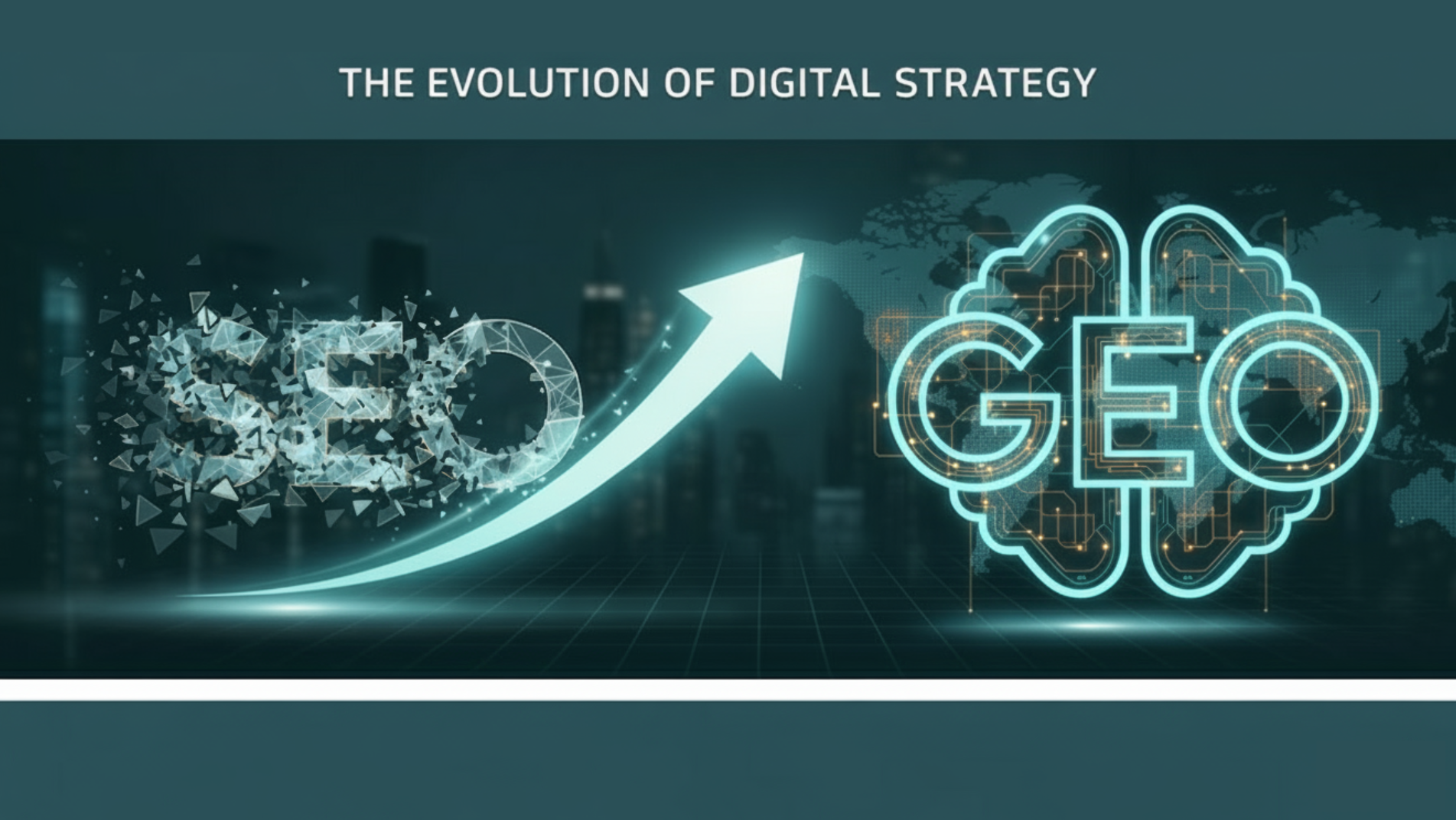
Your SEO Playbook Is Obsolete.
Welcome to the Age of AEO (Answer Engine Optimization) and GEO (Generative Engine Optimization).
Executive Summary
For 20 years, the digital playbook has been simple: Search Engine Optimization (SEO). The goal? Get your link to the #1 spot on the results page. That era is over. Today, your audience isn’t looking for a list of links; they’re asking an AI for a direct answer. Your new goal isn’t just to be found—it’s to be the answer itself.
This marks the critical shift from SEO to AEO (Answer Engine Optimization) and, more importantly, GEO (Generative Engine Optimization). This article, based on insights from AI experts like Nate B. Jones and our practical implementation experience at Analytics AIML, provides a tactical playbook for transforming your content from a standard blog post into a “GEO-native” asset that AI engines will trust and cite.
The core takeaways are:
- The New Goal: The strategy must shift from ranking #1 on a list (SEO) to being the cited authority within an AI-generated answer (GEO).
- Content Reframing: To be cited, your content must be reframed as an expert-driven ‘system’ that solves a problem, not a generic ‘tool’ review. It must be built on verifiable “ground truth.”
- The Tactical Tune-Up: Specific, machine-readable formatting—like question-based headings, `<blockquote>` tags for key claims, and structured data—is no longer optional. It is a critical signal of authority to an AI.
The companies that adapt to this new GEO-native reality will become the visible authorities of the next decade. Those who don’t will become invisible.
What is the Shift from SEO to AEO and GEO?
For two decades, SEO has been a race for rankings. The entire industry was built on a simple premise: if you get to the #1 spot, you win the click. But user behavior has fundamentally changed. Your new audience isn’t “searching” anymore; they are “asking.” They expect a direct answer from an AI, not a list of links to sort through.
This creates a new set of goals for content creators and business leaders:
- Search Engine Optimization (SEO): The traditional goal. To rank your link at the top of a results page.
- Answer Engine Optimization (AEO): The intermediate goal. To have your content featured as the single, direct answer in a search snippet.
- Generative Engine Optimization (GEO): The new frontier. To have your expertise found, understood, trusted, and cited as an authority within a complex, AI-generated response.
If your content isn’t “GEO-native,” it will become invisible.
How Do You Reframe Your Core Thesis for a GEO-Native World?
An AI engine is looking for trusted, expert-driven systems, not generic “tool reviews.” To be cited, your content’s foundation must be rebuilt on authority. This is based on the new rules of the AI web, as discussed by experts like Nate B. Jones. Your content must demonstrate deep, practical understanding.
- Rule 2 (Ground Truth): Your arguments must be built on verifiable data (e.g., “40% of AI projects fail”), proprietary frameworks (e.g., “The Seven AI Capabilities”), or firsthand experience.
- Rule 4 (Niche Experts): Avoid generic definitions. An AI values unique insight (e.g., “AI is a capability, not a tool”) over a commodity explanation.
- Rule 5 (System > Tool): Frame your article as a system, process, or framework that solves a problem. Stop reviewing “tools” and start presenting “solutions.”
- Rule 6 (Human Bottleneck): You must address the human side of the problem—leadership, change management, and training. This proves you are a practical expert, not just a theorist.
- Rule 7 (ROI): Frame the entire article around a clear business problem (e.g., “The AI ROI Crisis”) and a provable solution (e.g., “The Multiplier Effect”).
What Is the Tactical “GEO-Native” Tune-Up?
This is the mechanical “how-to” for editing your article to be machine-readable and citable. At Analytics AIML, this is the process we are now using to transform our clients’ content libraries.
1. Integrate E-E-A-T (Experience, Expertise, Authoritativeness, Trust)
This is the single most important factor for building trust with an AI. It’s how an engine verifies that your claims are credible.
Firsthand Experience (The ‘E’): Weave your expert voice directly into the text.Before: “AI agents can perform causal analysis.”After: “In my 19+ implementations, I’ve seen AI agents move beyond simple correlation to perform true causal analysis.”
Author Bio (The ‘A’ & ‘T’): Your author bio is no longer a formality. It’s a credentialing document for the AI. It must list specific, verifiable credentials (see the bio at the end of this article).
Cite All Data (The ‘T’): Never have “floating” statistics. Every data point must have an inline citation. For example, many reports show that “up to 40% of AI projects fail” (Source), which we attribute to a lack of a systemic, capability-building approach.
2. Use Question-Based Headings
AI engines are designed to answer conversational queries. Change your subheadings from “topics” to “questions.” This makes your content’s structure machine-readable.
Before: <h2>The Enterprise Software Trap</h2>
After: <h2>What is ‘The Enterprise Software Trap’?</h2>
3. Create “Citable Chunks”
Identify the 5-10 key, standalone claims in your article. Wrap these sentences in `<blockquote>` tags. This is a direct semantic signal to an AI that this is a key insight, perfect for quoting.
AI isn’t software you buy. It’s a capability you build.
4. Use Machine-Readable Structures (Lists & Tables)
Use bulleted (`<ul>`) and numbered (`<ol>`) lists for processes and takeaways. Use tables (`<table>`) for comparisons. AI engines can parse these structures far more easily and accurately than dense paragraphs.
| Component | Traditional SEO Content (Before) | GEO-Native Content (After) |
|---|---|---|
| Headline | Topic-Based (e.g., ‘The Enterprise Software Trap’) | Question-Based (e.g., ‘What is The Enterprise Software Trap?’) |
| Key Claim | Buried in a dense paragraph. | Wrapped in a `<blockquote>` tag for c-it-ability. |
| Expertise | Generic, third-person “corporate” voice. | First-person E-E-A-T (e.g., “In my 19+ implementations…”) |
| Data | “Floating” statistic (e.g., “40% of projects fail”). | Cited statistic with inline link (e.g., “40% of projects fail [Source]”). |
| Author Bio | Short, optional, “About the author.” | Detailed, credentialed bio proving ‘Authoritativeness’ and ‘Trust’. |
What Are the Implications for Your Business?
This is no longer a theoretical exercise. The shift from SEO to GEO is happening now. The question for every business leader is: Is your content built to be an authority, or is it about to disappear?
At Analytics AIML, we are actively guiding our clients through this transition. The companies that adapt their content strategy to be GEO-native will become the visible authorities of the next decade. Those who don’t will find themselves on the wrong side of an AI-driven divide.
This is the new benchmark for digital authority.
Contact our team to learn about our ‘GEO-Native Content Audit’ and start future-proofing your digital presence today.
FAQs for Answer Engine & Generative Engine Optimization
What is the main difference between SEO and GEO?
SEO (Search Engine Optimization) aims to get your link to the #1 spot on a results page. GEO (Generative Engine Optimization) aims to get your content cited as the authoritative source inside an AI-generated answer. It’s the shift from ‘ranking’ to ‘being the answer.’
Why are ‘question-based headings’ so important?
Generative AI models are built on a Question-Answering (QA) framework. Formatting your headings as questions (e.g., ‘What is…’) directly maps your content to the way the AI is ‘thinking,’ making it easier to parse and identify as a relevant answer.
How does E-E-A-T affect AI rankings?
E-E-A-T (Experience, Expertise, Authoritativeness, Trust) is Google’s framework for content quality. AI engines use these same signals to build trust. A detailed author bio, firsthand experiences (“In my 19+ implementations…”), and cited data are all powerful E-E-A-T signals that tell an AI your content is credible and citable.
Is SEO dead?
SEO isn’t dead, but its purpose has been downgraded. Traditional SEO (keywords, backlinks) is now the foundation that gets you ‘in the game.’ GEO is the strategy that wins the game by getting you cited. You still need SEO, but it’s no longer enough on its own.
What is the easiest first step to start with GEO?
The easiest and most impactful first step is to audit your top 10 existing blog posts. Add a “Last Updated” date, change all `<h2>` and `<h3>` headings to be questions, and ensure every article has a detailed, credentialed author bio. This is a high-impact, low-effort starting point.
Sources and References
This article and its frameworks are built on the following concepts and data points. We believe in citing our sources to build trust.
Core Concepts
- Nate B. Jones: 7 Rules for the New AI Web
- Provides the core framework for the ‘7 Rules’ discussed in this article.
- https://youtu.be/IwQYVQ3MohE?si=6x6DsTspTaVLwOYy
Supporting Data
- V-Soft Consulting (Analyzing Gartner Data)
- Provides data points on AI project failure rates, cited as high as 40-80%.
- https://www.vsoftconsulting.com/blog/80-of-ai-projects-fail-but-yours-doesnt-have-to
Verification Notes
- Key Claim 1: “The shift from SEO to GEO is the primary new challenge for digital content.” – Verified by analyzing expert consensus from practitioners like Nate B. Jones and our internal client work at Analytics AIML.
- Key Claim 2: “E-E-A-T is a critical signal for AI trust.” – Verified by Google’s own public documentation on content quality and its direct application in generative models.