— Published 2025 · Analytics AIML, LLC
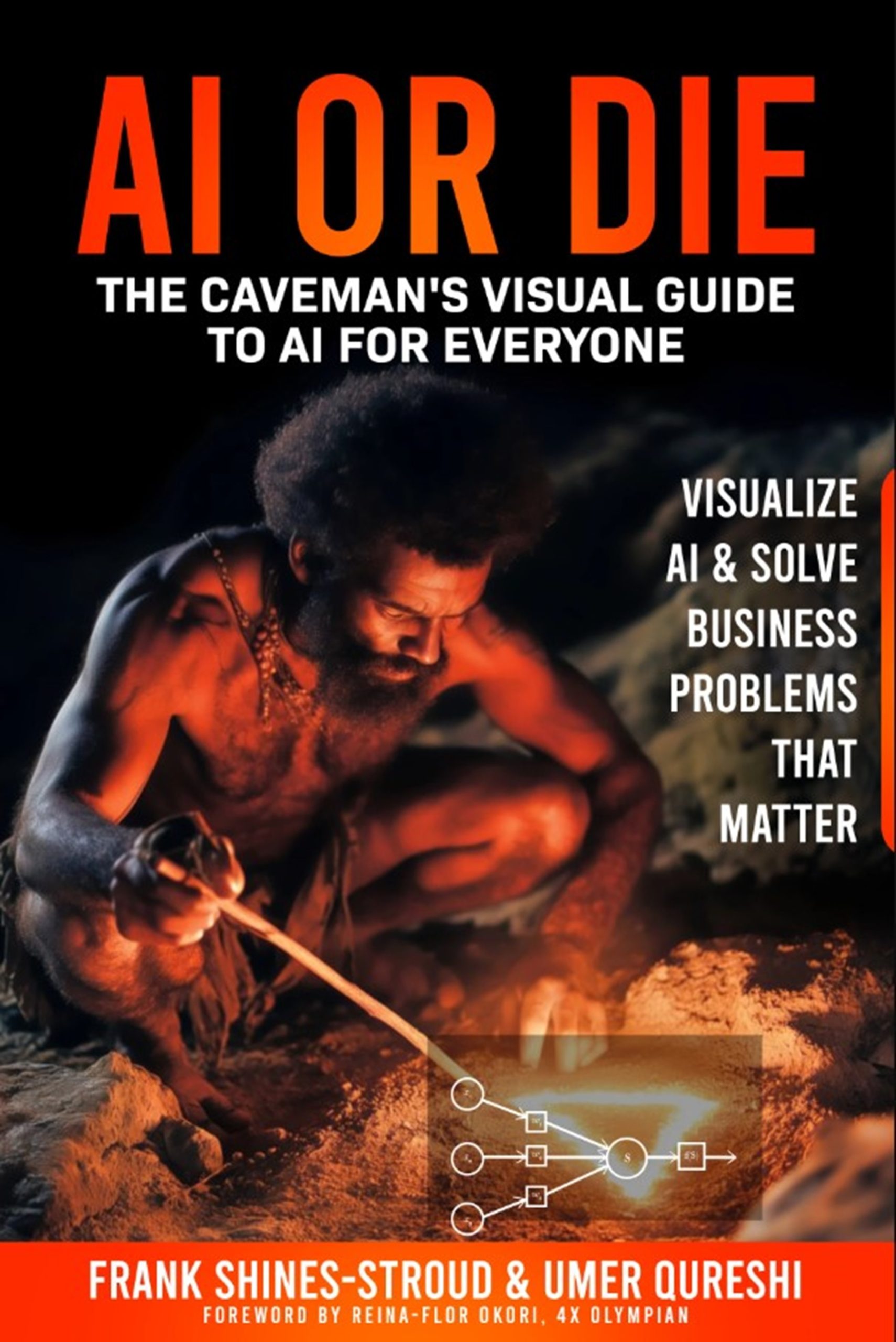
AI or Die.
The Caveman’s Visual Guide to AI for Everyone.
Our ancestors read the stars to survive. We can master AI to thrive. A visual fieldbook that turns pattern recognition — the oldest human skill — into the sharpest edge your team can build for what comes next.
By Frank Shines & Umer Qureshi · Foreword by 4× Olympian Reina-Flor Okori
— The premise · Caves to code
A book about AI that starts, of all places, on a cave wall.
Because forty thousand years before the transformer, our ancestors were already doing the hardest thing AI does today: turning noisy signals from the world into a story their tribe could act on.
This book started in the middle seat of a red-eye, after a long day watching a smart client burn millions on an AI pilot that never should have shipped. The room had every credential you could want. What it didn’t have was a sharp problem, a shared mental model, and the discipline to say the quiet part out loud: nobody in the meeting could draw what AI was actually doing.
That’s the gap this book closes. Not with equations. Not with hype. With pictures — the way our species has always taught the hard stuff. From the Lascaux caves to the Apollo capsule, humans have moved forward by drawing the pattern first and doing the math second. AI works the same way. If you can see it, you can steer it.
AI or Die is a fieldbook, not a textbook. Keep it on the desk. Dog-ear the pages. Search it when the CFO asks a hard question and you have twenty minutes to have an opinion. It’s built for the way real work actually gets done.
If our ancestors could read the stars to survive, we can master AI to thrive.
— Frank “Rio” Shines, Chapter 1
A visual guide. A working reference. A quiet argument for pattern recognition as the last durable edge.
— Who it’s for · Three readers, one book
Written so a Chief AI Officer, a first-year analyst, and a curious teacher all get their money’s worth.
Two navigable paths, one shared vocabulary. Read the express lane in an afternoon, or take the practitioner’s route and use the same book for a year of implementation.
01 · The Executive
You have to decide, not code.
Follow Path 1 · Executive Express: the mental models, the language, and the tradeoffs. Enough to run a board meeting on AI without nodding at things you do not actually understand.
02 · The Practitioner
You have to ship, not just brief.
Follow Path 2 · Practitioner’s Journey: everything the executive needs, plus the frameworks, the diagrams, and the coach-and-do exercises. A working blueprint from problem to production.
03 · The Curious
You want to understand, not fear.
Skim the table of contents like a menu. Search for the term that keeps showing up in the news. Come back when you need to. It is a fieldbook — it rewards the flip-through, not the marathon.
— How to read this book · A note from the authors
Listen — this isn’t homework.
Think of it like the shop manual you keep in your garage.
AI or Die is not meant to be read cover-to-cover on a flight — though you could. It is the reference you grab when something breaks or you are trying to figure out if that noise is normal. Here is how most readers actually use it:
Got 10 minutes?
Search the index. Look up hallucination, ROI, agent. Find the page. Get an answer. Close the book.
Got 2 hours?
Path 1 · Executive Express. The strategic view, without drowning in the technical detail.
Building something?
Path 2 · Practitioner’s Journey. Everything in Path 1, plus the implementation blueprint.
Just browsing?
The table of contents is a menu. Pick what looks interesting. Skip what does not. Come back later when it matters.
The pages are built to be marked up, dog-eared, and coffee-stained. This is a working book. And because AI moves fast, we keep free companion resources — including a 100+ slide coach-and-do training deck — updated at analyticsaiml.com/books. Do not let perfect be the enemy of good. Start where you are.
— Inside · Fifteen themes
The chapters your team will keep coming back to.
Fifteen visual chapters. Every one earns a place on the wall of a war room somewhere. A representative sample, in the order they appear.
01
What AI Teaches Us About Ourselves
Building AI forced us to describe human cognition in ways we never had to before. The mirror is worth looking into.
02
The Ability of AI to Manipulate Society
Recommendation, persuasion, synthetic media — the leverage AI puts in the hands of the few who understand it.
03
AI Trained on Flawed Code Becomes a Psychopath
Why garbage in, garbage out got exponentially more dangerous when the garbage learned to reason.
04
GIGO Goes Global
What happens when the whole planet starts training on each other’s synthetic exhaust. And what to do about it.
05
The End of Apps & Systems as We Knew Them
The interface is dissolving into the conversation. What the enterprise stack looks like when the app layer thins out.
06
The Rise of the AI-Powered Elite
The gap between people who use AI as a search box and people who use it as a co-worker is already priced into the labor market.
07
A Renaissance of Reasoning
First-principles thinking is having its second act. The people who can decompose a problem will run the ones who cannot.
08
The New Science of Learning to Earning
A generation is about to skip the degree and monetize the skill. What that means for hiring, training, and the P&L.
09
The 5 C’s of the AI Da Vincis
Curiosity. Craft. Compression. Curation. Courage. The five traits that separate operators from spectators.
10
Why Today’s LLMs Won’t Reach AGI
The uncomfortable technical argument, drawn on a napkin. And why that is not the reason to stop paying attention.
11
AI Pics Worth a Thousand Words
The full visual glossary. Statistical distributions that feel human. Diagrams that stick.
12
Beyond Extreme Lean
Where art, EQ, discovery, and a new era of wealth creation converge — after the last productivity gain has been squeezed out.
13
From SDLC to ATC
The AI Transformation Cycle. What the software development lifecycle looks like when the code writes back.
14
Building Apps Faster Than Googling It
The disposable-app era. When it is cheaper to ship a custom tool than to search for one, workflows change.
15
The Coach & Do Training Deck
The 100+ slide companion deck — updated free at analyticsaiml.com/books — that turns each chapter into a workshop.
— Foreword · Reina-Flor Okori
A four-time Olympian on why pattern recognition is the only edge that lasts.
R·F·O
4× Olympian · 100m Hurdles
“What Frank and Umer have done is take the hardest thing in modern business — knowing what to pay attention to — and turn it back into a human skill anyone can build.”
Reina-Flor Okori · Four-time Olympian, 100m Hurdles · France / Equatorial Guinea
Reina-Flor writes the foreword because the argument of the book is not technical — it is athletic. The people who win with AI are the ones who train the ancient skills the coaches do not measure: attention, tempo, and the pattern under the noise.
— The authors · Two operators, one book
Written by people who have had to ship this stuff, not just talk about it.
A four-time published author and Lean Six Sigma Master Black Belt, and a working platform engineer. The book is the field notes from three decades of getting transformations to actually stick.
Author · Founder & CEO, Analytics AIML
Frank “Rio” Shines
Presidential appointee to the U.S. Air Force Academy. Captain of the NCAA men’s gymnastics team. Trained student pilot. Three decades inside IBM, Ernst & Young, Express Scripts, and Fortune 500 transformations across defense, pharma, manufacturing, and edtech.
Lean Six Sigma Master Black Belt trained under Dr. Mikel J. Harry at Motorola University. Four-time published author, including The Controller’s Function (Wiley, 2000). His nickname — Rio — comes from a decade in Brazil, where he learned that the best insights arrive in a second language.
USAFA · Lean Six Sigma MBB · IBM & EY · 4× author
Co-Author · Co-Founder & CTO, Analytics AIML
Umer Qureshi
Platform engineer and technical practice lead. Runs the agentic AI, RAG, and content engine stack that makes the frameworks in this book actually run in production — for clients from B2B logistics to higher-ed infrastructure.
Umer’s role in AI or Die is the one every serious technical book needs and rarely gets: making sure the diagrams still work when you put them in front of a real engineer at 3pm on a Wednesday.
Agentic AI · RAG & Vector · Platform · Databricks
— From the page to the P&L
Like the thinking? Put it to work.
The book makes the case. The AIM Suite ships the result. Start with a free excerpt — or a thirty-minute diagnostic with the founders.
— The objections answered
Frequently Asked Questions (FAQs)
Is this a technical book?
No — and yes. It is technical about how AI actually works and what makes it fail, but it uses pictures and pattern recognition instead of formulas. A non-engineer can follow every chapter. A senior engineer will still find things they have not seen framed this way.
Do I need to read it cover-to-cover?
Please do not. It is a fieldbook. Skim the table of contents, pick a chapter that solves the problem in front of you today, and come back for the next one when the next problem shows up. That is how it was written to be used.
What is the difference between Path 1 and Path 2?
Path 1 · Executive Express is the strategic reader’s route — the mental models, tradeoffs, and vocabulary. Path 2 · Practitioner’s Journey adds the implementation frameworks, coach-and-do exercises, and diagrams a team can actually build against. Same book, two navigations.
Who is Reina-Flor Okori and why did she write the foreword?
Reina-Flor is a four-time Olympian in the 100m hurdles for France and Equatorial Guinea. She writes the foreword because the argument of the book is not technical — it is athletic. The skill that decides who wins with AI is the same skill that decides who wins a hurdles race: seeing the pattern under the noise, faster than the person next to you.
Is there a companion training deck?
Yes. A 100+ slide coach-and-do training deck lives free at analyticsaiml.com/books, and we update it as the tooling changes. Because the field moves faster than any print run.
Can Frank speak or lead a workshop for our team?
Yes — keynotes, executive workshops, and AI-or-Die-in-a-Day hands-on sessions built from the book. Start with the Flight Recorder diagnostic; if it is a fit, we will scope the engagement.
Where can I buy it?
The excerpt is free — request it at the bottom of this page and we will email it to you. Purchase links and additional distribution details are updated on the Books page as they become available. If you are an enterprise buyer looking for a team bulk order, send us a note and we will come back to you with pricing.
— The free excerpt · Straight to your inbox
Read the opening chapters on the house.
Tell us where to send it and the excerpt is on its way. No spam — just the book, and the occasional note when the companion deck is updated.