
From as early as I can remember until I graduated from high school, I was fascinated with art and studied it with the goal of becoming a graphic artist at Disney Studios in Los Angeles. Much has changed since those early days.
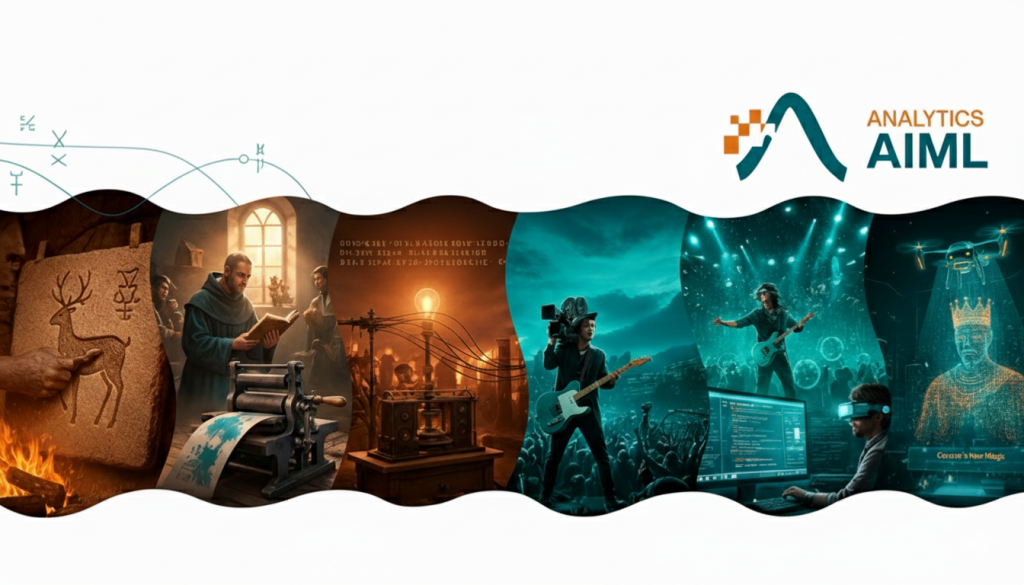
Consider how technology has shaped creation across 40,000 years. What does the current AI revolution mean for the future of content, both real and fake?
Executive Summary
Generative AI represents the final stage of a 40,000-year cycle of technological disruption in content creation. Historically, every new tool—from the printing press to digital software—has followed a predictable pattern: dramatic democratization of creation, followed by market consolidation around new gatekeepers.
We are now entering the ultimate democratization phase. AI is driving the marginal cost of high-fidelity content creation toward zero, fundamentally breaking the traditional link between resources (time, budget, specialized skill) and execution.
For the first time, the primary bottleneck to value creation is no longer capital or technical talent, but the clarity of a business’s vision and its ability to articulate it. In this new paradigm, the competitive advantage shifts from how you create to what you can imagine. Leaders must now focus on building a culture of strategic imagination to capitalize on this shift.
The core insights are:
- The Creator’s Gambit Is Universal: From the scribe’s stylus to AI models, every major content technology has followed the same cycle: democratization through new tools, followed by consolidation of power around those who control the infrastructure.
- Cost Drives Everything: The relentless reduction in the cost of content creation—from years of training to seconds of computing—has been the primary driver of social, economic, and cultural change throughout history.
- The New Scarcity: In a world of infinite, machine-generated content, the ultimate scarcity is no longer creation itself, but authenticity, trust, curation, and taste. The future belongs to those who can discern, not just generate.
- We’re Not in Another Turn—We’re at the Inflection Point: AI-powered content generation represents not just another disruption, but the culmination of a 40,000-year trajectory toward zero-cost creation.
This is not just a history of art or technology—it is the story of how humans have always used new tools to reshape reality itself. The infinite canvas is here. The question is: what will we create on it?
Introduction: The Creator’s Gambit
Deep within the earth, in a silence broken only by the drip of water and the beat of a human heart, a hand is pressed against cold limestone. A mouthful of ground ochre and charcoal is sprayed over it, and when the hand is pulled away, its ghostly negative remains—a signature, a claim, a piece of data permanently stored on a stone canvas 40,000 years ago.
Today, in a room illuminated by the glow of an OLED screen, a creative director types a string of words: “Photorealistic image of a lone astronaut looking at a swirling nebula, style of Ansel Adams, 8k, dramatic lighting.” Seconds later, a machine that has ingested a significant portion of humanity’s visual history generates a dozen unique, breathtaking options, any one of which could grace the cover of a magazine.
Are these two acts of creation—one born of ritual and survival, the other of algorithms and electricity—fundamentally different? Or are they merely two points on the same, violently accelerating curve of human expression?
The history of content generation is not a quaint story of art; it is a brutal, exhilarating story of technology and economics. It is a relentless cycle of disruption where new tools first democratize the means of creation, then centralize power in the hands of those who control the new infrastructure. Each turn of this wheel has relentlessly lowered the cost of execution while raising the stakes of originality and control. From the shaman’s chant to the scribe’s stylus, the painter’s brush to the printer’s press, and the photographer’s lens to the programmer’s code, the story is the same: a new technology shatters the old way of doing things, unleashes a torrent of new content, and forges a new class of creator and a new kind of king.
We are not just in another turn of this cycle. We are at a planetary-scale inflection point, a moment where the very definition of creation is being refactored into lines of code. The barrier between imagination and execution is evaporating. To understand the seismic shifts of the present—the rise of foundation models, the venture capital gold rush, the existential questions facing every creative professional—we must first understand the deep history of this process. This report traces that history through six distinct ages, revealing the unyielding patterns of disruption that connect the caves of Lascaux to the server farms of Silicon Valley. This is the story of the creator’s gambit: the timeless human wager that a new tool can unlock a new world.
| Era | Primary Creator Role | Funding Model | Distribution Method | Cost to Create / Consume |
|---|---|---|---|---|
| Nomadic (c. 40,000-10,000 BCE) | Shaman / Hunter-Artist | Community / Ritual | Oral Tradition / Parietal Art | Extremely High (Time/Risk) / Low (Community Access) |
| Agricultural (c. 10,000 BCE – 1760 CE) | Scribe / Priest | State / Temple Patronage | Manuscript / Hieroglyph | High (Materials/Training) / Very High (Elite Access) |
| Renaissance (c. 1450-1760 CE) | Artisan / Court Artist | Noble / Church Patronage | Printed Book / Sheet Music | High (Skill/Materials) / Moderate (Elite Market) |
| Industrial (c. 1760-1950) | Mass Media Professional | Mass Market (Advertising/Sales) | Broadcast / Physical Media | Lower (Industrialization) / Low (Mass Access) |
| Information (c. 1950-2020) | Digital Creator | Platform Economy (Ad-share/Subscription) | Internet / Social Media | Very Low (Digital Tools) / Freemium |
| AI (c. 2020-Present) | Prompt Engineer / AI Collaborator | Venture Capital / API Access | API / Cloud Inference | Near-Zero (Generative Models) / Subscription |
Part I: The Age of Ritual – Content as Survival (c. 40,000 – 10,000 BCE)
The First Boardroom: Inside Lascaux
To understand the genesis of content, one must descend into the caves of southwestern France and southern Spain. Here, in the flickering torchlight, our Paleolithic ancestors created the first permanent records of human thought. These were not idle doodles. The paintings of Lascaux and Chauvet were high-stakes, resource-intensive projects undertaken in dangerous and inaccessible locations, suggesting a purpose far more profound than mere decoration. They were the output of the first content strategists.
The technology stack, though primitive, was sophisticated. Artists used a limited but effective palette of mineral pigments—red and yellow ochre, hematite, manganese oxide, and charcoal—ground on stones and mixed with a binder like water. They applied these pigments using a variety of techniques: finger tracing, swabs of fur, and even a form of prehistoric airbrushing, where pigment was blown through a tube or directly from the mouth to create the soft, stippled effect seen in hand stencils.
More remarkably, these artists demonstrated an intuitive grasp of three-dimensional space, using the natural bulges and contours of the cave walls to give their animal figures a sense of volume and life—a primitive form of 3D rendering that would not be rediscovered for millennia. The famous “Crossed Bison” in the Nave of Lascaux, with its use of perspective to depict the far legs behind the near ones, is a testament to a level of artistic skill that was anything but primitive.
The Business Case for Cave Art: The business case for this enormous effort remains a subject of debate, but the leading theories point to a clear, functional return on investment. The “hunting magic” hypothesis suggests the paintings were part of rituals designed to ensure success in the hunt, a form of sympathetic magic to gain power over the massive, dangerous animals depicted. Another theory frames the art as a form of communication, a way to record stories, myths, or perhaps even maps of hunting grounds.
The scientist Jacob Bronowski saw in these images something more profound: “the power of anticipation”. By painting the bison and the aurochs, the hunter could visualize the coming encounter, plan for its dangers, and mentally rehearse the act. In this view, the caves were not temples, but the world’s first strategic planning centers, and the art was the first data visualization, content with a clear, life-or-death function.
This explosion of creativity, which appears in the archaeological record around 40,000 years ago, is often called “the mind’s big bang”. Coinciding with the arrival of anatomically modern humans in Europe, this period saw the emergence of not just painting, but sculpture, engraving, and personal ornamentation like shell beads. This was more than art; it was the external manifestation of a new cognitive operating system. Symbolic thought—the ability to make one thing stand for another—was an evolutionary game-changer. It allowed for complex language, the formation of social identities, and long-term planning. In a world of constant peril, art had a powerful adaptive value; it was a technology for survival.
The Original Content Platforms: Music and Oral Tradition
The creative drive of this era was not confined to the visual. In the Divje Babe cave in Slovenia, archaeologists found a fragment of a cave bear femur, pierced with deliberate holes. Dated to 60,000 years ago, it is believed to be a flute made by a Neanderthal. While its status is debated, other flutes made from vulture wing and swan bones, dating back over 40,000 years, have been found in Germany. These instruments represent the birth of another content medium: structured sound. Music, likely used in rituals and for social bonding, was another tool for building the cohesive groups necessary for survival.
Before the permanence of paint on rock or the replicability of a melody, however, there was the spoken word. For tens of thousands of years, oral tradition was the sole medium for storing and transmitting a culture’s most critical data: its history, laws, genealogies, and creation myths. It was a living, breathing database, a human cloud. This system was not random; it was a highly structured technology of memory. In many societies, professional performers—the guardians of collective memory—were held in the highest regard, their recitations governed by strict rules of performance to ensure fidelity across generations.
Yet, this human cloud had critical vulnerabilities. Its reliance on human memory made it susceptible to corruption. With each retelling, details could be lost, biases could creep in, and meanings could be distorted. A story might be altered to flatter a new chief, or a crucial detail in a legal proverb might be forgotten. The death of a key storyteller or an entire generation through war or famine could result in a catastrophic loss of data, wiping out a culture’s identity and accumulated wisdom.
The very nature of early human content reveals its fundamental purpose. It was not entertainment; it was a cognitive technology.
Cave art, music, and oral traditions were tools that allowed early humans to abstract thought from the immediate present, to plan for the future, to build the social cohesion necessary for large-group cooperation, and to store vast quantities of information outside the confines of a single brain. This was the foundational software that ran on the newly upgraded hardware of the modern human mind. However, the inherent fragility of the oral tradition—this first, human-based cloud storage system—created a massive, latent market demand. As societies grew, the need for a more robust, scalable, and permanent information storage technology became acute. This set the stage for the next great disruption, an invention born not of artistic impulse, but of administrative necessity.
Part II: The Ledger and the Scribe – Content as Control (c. 8,000 BCE – 1450 CE)
The Killer App of the Agricultural Age: Accounting
The narrative of content pivots from the caves of Europe to the fertile river valleys of Mesopotamia. The Agricultural Revolution, beginning around 10,000 BCE, was a cataclysmic shift in the human story. For the first time, settled societies could produce a surplus of goods—grain, livestock, textiles, and pottery. This surplus was the fuel for the first cities, the first kingdoms, and the first empires. But it also created a problem of unprecedented scale: how to keep track of it all.
The answer to this problem was the invention of writing, and its killer app was accounting. The earliest known script, the Mesopotamian cuneiform, did not emerge to record poetry or history, but to document simple commercial transactions. The system evolved directly from the practical needs of a burgeoning bureaucracy. It began around 8,000 BCE with three-dimensional clay tokens, each shape representing a specific commodity—a cone for a small measure of grain, a sphere for a larger measure, an ovoid for a jar of oil. To record a transaction, one would simply group the corresponding tokens.
By 3,500 BCE, these tokens were being replaced by two-dimensional pictographic signs pressed into wet clay tablets. A drawing of a sheep next to a numerical mark was faster and more efficient than four separate sheep tokens. This was a critical step in data abstraction. The final leap occurred around 3,200 BCE, when these pictographs were refined into the abstract, wedge-shaped marks of cuneiform, a logo-syllabic system where signs could represent either a whole word or a phonetic syllable.
The technology stack was simple but world-changing. The primary medium was the clay tablet, an abundant and durable resource. The primary tool was the stylus, typically a reed cut to a wedge-shaped tip. This combination allowed for the rapid and standardized recording of vast amounts of data. In Egypt, a parallel system, hieroglyphics, emerged around the same time, though whether it was an independent invention or inspired by cuneiform is still debated. While hieroglyphs are famous for their monumental inscriptions on stone, a cursive form called hieratic was used for everyday administrative tasks on papyrus, a much more portable, if less durable, medium. Both systems served the same core function: to be the operating system of a complex agricultural state, managing everything from grain harvests and tax collection to religious rituals and royal decrees.
The Rise of the Scribe: The First Information Technocrats
The invention of these complex writing systems, with their thousands of characters, created a new and powerful profession: the scribe. Literacy was not a common skill; it was a highly specialized trade requiring years of rigorous training in temple schools. This steep learning curve created a small, elite class of information technocrats who held a monopoly on the ability to read and write.
Scribes were far more than mere copyists. They were the administrative and intellectual backbone of ancient civilizations. In Mesopotamia and Egypt, they functioned as accountants, lawyers, engineers, and civil servants. They recorded laws like the famous Code of Hammurabi, drafted contracts, managed the logistics of massive public works like pyramids and irrigation canals, and kept the meticulous records of tribute and taxation that funded the state. Their status was immense. In Egypt, scribes were exempt from taxes and manual labor, and a scribal career was a path to wealth and high office. The ability to write was the ability to wield power. Scribes were the gatekeepers of knowledge, the interface between the ruling class and the populace, and their control over the flow of information was a form of control over society itself.
This era cemented a fundamental shift in how societies were organized. Writing was the technology that allowed human civilization to scale beyond the village or tribe. The oral tradition of a small group could manage local customs and histories, but only the permanent, objective, and scalable record-keeping of writing could manage the complexities of an empire with vast territories, complex economies, and stratified social hierarchies. It solved the data-permanence problem that had plagued the oral “cloud” and enabled the creation of the first large-scale, centrally administered human systems.
The First Digital Divide: However, this powerful new technology also introduced a profound and lasting schism into society. The difficulty of mastering early writing systems created the first great “digital divide”: a tiny literate elite who could “write” to the system—the scribes, priests, and rulers who created the laws and records—and a vast illiterate majority who could only “read” the outputs in the form of commands, decrees, and tax bills. This established a centralized, top-down information architecture that would define civilization for the next three millennia. The power to write the official record was the power to define reality. This dynamic, where a small group of technocrats builds and controls the information systems that shape the lives of the many, is a pattern that would repeat itself with every subsequent technological revolution.
Part III: The Patron and the Polymath – Content as Prestige (c. 1450 – 1760)
Florence as a Venture Capital Hub
The center of our story shifts to Renaissance Italy, specifically the bustling, competitive city-state of Florence. Here, a new form of content creation emerged, driven not by the survival needs of the tribe or the administrative needs of the state, but by the ambitions of a new class of merchant bankers. This was the birth of the modern creator economy, and its fuel was patronage.
Wealthy families like the Medici operated as the world’s first venture capitalists for the arts. Their immense wealth, derived from banking and trade, was strategically deployed to fund the most promising artistic “startups” of the day. They didn’t just purchase finished artworks; they identified and cultivated talent, providing long-term financial support that liberated geniuses like Leonardo da Vinci, Michelangelo, and Botticelli from the daily struggle for subsistence. This patronage allowed artists to undertake hugely ambitious, multi-year projects—from the frescoes of the Sistine Chapel to the bronze doors of the Florence Baptistery—that would have been impossible otherwise.
This was not charity; it was a high-stakes investment. The relationship between artist and patron was formalized through detailed, legally binding contracts, often drawn up by a notary. These “term sheets” specified everything: the final price and payment schedule, the quality of materials to be used (stipulating the use of expensive pigments like ultramarine blue or gold leaf was common), the subject matter and figures to be included, and strict deadlines. For the patrons, the return on this investment was not direct financial profit, but the far more valuable currency of prestige. In the cutthroat world of Italian city-states, commissioning a magnificent work of art was a public declaration of wealth, piety, taste, and power. It enhanced a family’s social standing and served as a powerful tool of political influence and diplomacy. This intense competition among patrons to secure the services of the most famous artists created a white-hot market for innovation, pushing creators to new heights of technical and conceptual brilliance.
A Technological Arms Race in Realism
This competitive hothouse environment fostered an explosion of new artistic technologies, all aimed at achieving a single goal: a more perfect, convincing illusion of reality. The flat, stylized figures of the medieval period were replaced by a new, powerful naturalism.
The new tech stack was revolutionary. The development of oil painting, likely originating with Flemish artists like Jan van Eyck and then adopted in Italy, was a game-changer. Unlike the fast-drying egg tempera that preceded it, oil paint dried slowly, allowing artists to blend colors seamlessly and create subtle gradations of light and shadow, achieving a depth and luminosity never before seen. This new medium enabled a suite of new techniques. The formalization of linear perspective, pioneered by the architect Filippo Brunelleschi, provided a mathematical system for creating a convincing illusion of three-dimensional space on a two-dimensional surface. Artists used vanishing points and horizon lines to construct rational, believable worlds for their figures to inhabit. Techniques like chiaroscuro (the dramatic use of light and dark) and contrapposto (the naturalistic S-curve posture of the human body) added to the sense of volume, drama, and life.
No one exemplified this fusion of art and science more than Leonardo da Vinci. His proprietary technique, sfumato, was his killer app. Derived from the Italian word for “smoke,” it involved applying dozens of incredibly thin, translucent layers of oil glaze to create imperceptible transitions between colors and tones, completely eliminating hard outlines. The ultimate demonstration of this technology is the Mona Lisa. Her famously enigmatic smile is not a line, but a complex illusion created by the subtle, smoky shading at the corners of her mouth and eyes. It was the product of years of obsessive scientific research into optics, human anatomy, and the physics of light, a masterpiece of both art and engineering.
The First Content Disruption: The Printing Press and Copyright
While the great masters were creating unique, irreproducible works for their elite patrons, a far more disruptive technology was taking hold. Johannes Gutenberg’s invention of the movable-type printing press around 1450 had already begun to revolutionize the written word. By 1501, another Venetian innovator, Ottaviano Petrucci, applied this technology to the printing of polyphonic music.
This was a profound shift. For the first time, a complex musical composition—an ephemeral, performance-based art form—could be transformed into a stable, mass-produced, and saleable commodity. But this new technology created a new business problem: piracy. Once Petrucci had gone to the immense effort and expense of setting the type and printing a book of motets, what was to stop a competitor from simply buying a copy, replicating it, and undercutting his price? The technology that enabled his business model also threatened to destroy it.
His solution was to turn to the law. Petrucci secured a 20-year exclusive privilege, or monopoly, from the Venetian Republic, forbidding others from printing music. This was the birth of modern music copyright. It was not a high-minded principle born from a desire to protect the rights of composers; it was a pragmatic business solution developed by a publisher to protect his capital-intensive manufacturing process from technological disruption. This act established a crucial historical precedent: whenever a new technology makes content easily and cheaply reproducible, a new legal or business framework must be invented to re-introduce artificial scarcity and protect the economic value of the content.
The Renaissance formalized the creator economy, elevating the artist from an anonymous craftsman to a celebrated genius with a bankable personal brand.
The patronage system, with its competitive bidding and legal contracts, was the first structured market for creative talent, a direct ancestor of the Hollywood studio system and today’s venture-backed creator platforms. At the same time, the era’s great technological disruption—the printing press—forced the creation of the legal architecture of copyright, a defensive framework designed to protect an old business model against a new technology. This fundamental tension—between technologies that promote abundance and business models that require scarcity—would come to define the entire future of content.
Part IV: The Press and the People – Content as Commodity (c. 1760 – 1950)
The Renaissance established the creator as a celebrated individual and content as a high-value asset. The Industrial Revolution took that asset and turned it into a mass-produced commodity, triggering an explosion in the volume, velocity, and accessibility of information that would permanently reshape society. This was the era of relentless industrialization, where a series of technological disruptions systematically dismantled the old barriers to content creation and distribution.
Disruption 1: The Steam-Powered Press and the Newspaper Boom
The first wave of this revolution was the application of steam power to Gutenberg’s press. In the early 19th century, machines like the Koenig press replaced manual labor, dramatically increasing printing speed and slashing production costs. The effect was staggering. In the United States, the number of newspapers skyrocketed from roughly 200 in 1800 to over 3,000 by 1860. Total annual circulation more than doubled in just over a decade, from 68 million copies in 1828 to 148 million by 1840.
This surge in volume was driven by a new business model: the “Penny Press”. Papers like the New York Sun abandoned the old model of expensive subscriptions aimed at a small political and mercantile elite. Instead, they sold their papers for a single cent, targeting a vast new audience of literate working- and middle-class city dwellers. The profit was no longer primarily in circulation revenue but in selling this mass audience to advertisers. Content shifted from partisan essays to sensational stories of crime, human interest, and scandal to capture the maximum number of eyeballs.
This information ecosystem was then supercharged by the telegraph. Invented by Samuel Morse in 1837, it represented a fundamental break in human history: for the first time, information was decoupled from the speed of physical transportation. A message that once took weeks to cross the Atlantic by ship could now arrive in minutes. This created the concept of “breaking news,” fueled the rise of wire services like the Associated Press, and allowed newspapers to provide their readers with a near-real-time view of national and world events.
Disruption 2: Photography – Capturing Reality
While the press was industrializing the word, a new technology was emerging to industrialize the image. In 1839, French artist and theater designer Louis Daguerre announced the daguerreotype, the first practical method of photography. A single, unique image created on a silver-plated copper sheet, the daguerreotype offered a level of realism that painting could never match. Initially, the process was complex and expensive, with a single portrait costing up to $6 in the 1840s. But competition and technical improvements drove prices down dramatically. By the 1850s, a daguerreotype could be had for 25 cents—a fraction of a carpenter’s daily wage of $1.50.
The true democratization of photography, however, came from an American bank clerk from Rochester, New York: George Eastman. Recognizing the cumbersome nature of glass plates and complex chemical processes, Eastman relentlessly innovated, first developing flexible roll film. Then, in 1888, he released a product that changed the world: the Kodak camera. It was a simple box camera that came pre-loaded with enough film for 100 pictures. For $25, a customer could buy the camera, take their photos, and then mail the entire device back to the company. Eastman’s firm would develop the film, print the pictures, and send them back along with the camera reloaded with a fresh roll of film. His business model was pure genius, encapsulated in the slogan: “You press the button, we do the rest”. Eastman made his real money not on the camera, but on the recurring revenue from film and processing. This masterstroke transformed photography from a specialized profession into a mass-market hobby, creating a visual chronicle of everyday life on an unprecedented scale.
Disruption 3 & 4: Capturing Time and Broadcasting Content
The final disruptions of this era captured time itself. In 1877, Thomas Edison invented the phonograph, a device that could record and play back sound. Initially conceived as a dictation machine, its most popular use quickly became recording music. This gave birth to the recorded music industry, turning a fleeting live performance into a permanent, saleable object. By 1914, Americans were buying over 27 million records annually.
Building on this work and the sequential photography of Eadweard Muybridge, Edison’s lab and inventors like the Lumière brothers in France developed the first motion picture cameras and projectors in the 1890s. For the first time, a medium could capture and reproduce movement, giving rise to the global film industry. The final paradigm shift was the move from physical media to broadcast. Radio in the 1920s and television in the 1940s and 50s made distribution instantaneous and untethered from any object, beaming content directly into the home. This created truly national, simultaneous cultural experiences and perfected the advertising-supported business model that would dominate media for the rest of the century.
| Medium | Pre-Invention Metric | Post-Invention Metric | Key Technology |
|---|---|---|---|
| Books in Europe | ~30,000 (Manuscripts, pre-1450) | ~9,000,000 (Printed, by 1500) | Gutenberg Press (c. 1450) |
| U.S. Newspapers (Annual Circulation) | 68 million (1828) | 500 million (1850) | Steam Press (c. 1814) |
| U.S. Records (Annual Sales) | Negligible (pre-1890) | 27.2 million (1909) | Phonograph (1877) |
| Transatlantic Message Speed | ~2 weeks (Sailing Ship) | ~Minutes (Telegraph) | Transatlantic Cable (1866) |
The Great Decouplings: The technologies of the Industrial Revolution triggered a series of “great decouplings” that fundamentally redefined content. The telegraph decoupled information from transportation. Photography decoupled the act of creating a realistic image from the years of manual skill required by a painter. The phonograph decoupled a musical performance from the specific time and place it occurred. Each innovation worked by removing a fundamental physical constraint, a process of abstraction that made content more portable, more reproducible, and more accessible.
This explosion of cheap, abundant content created a new economic reality. The scarce resource was no longer the content itself, but the audience’s attention. The business models of media pivoted to monetize this new scarcity. The Penny Press, yellow journalism, and advertising-funded radio were all innovations designed to capture and sell human attention. This marked the birth of the modern attention economy, a system where content is often the free bait used to lure an audience for advertisers. The economic logic forged in the noisy pressrooms and nascent broadcast studios of the 19th and early 20th centuries would lay the direct foundation for the business models of the internet age to come.
Part V: The Silicon Screen – Content as Simulation (c. 1950 – 2020)
The New Workshop: From Hollywood Soundstage to Render Farm
The next great transformation in content creation moved the workshop from the physical world to the digital realm. The invention of the computer heralded the ultimate decoupling: the separation of the image itself from any direct, physical referent in reality. This was the dawn of simulation, the era when light and shadow became programmable data.
The journey began not in Hollywood studios but in academic and military research labs. Early computer graphics were developed for practical applications like flight simulators, where the goal was to create a believable visual synthesis of reality for training pilots. Pioneers like Ivan Sutherland, whose 1963 “Sketchpad” was a forerunner of modern CAD software, and John Whitney, who used a WWII anti-aircraft computer to create the hypnotic spiral graphics for Alfred Hitchcock’s Vertigo (1958), laid the conceptual groundwork. These early experiments established that images could be generated mathematically.
The nexus of this new art form quickly became two California-based entities. The first was Industrial Light & Magic (ILM). When George Lucas was preparing to make Star Wars, he found that the in-house effects department at 20th Century Fox had been disbanded. In 1975, he founded ILM out of necessity, assembling a team of artists and engineers to create visual effects that had never been seen before. ILM became the world’s premier R&D lab for visual effects, mastering a hybrid approach that blended traditional techniques like model-making and matte painting with nascent digital technologies. In 1979, recognizing the potential of computer graphics, Lucas established a computer division within Lucasfilm, hiring Dr. Ed Catmull from the New York Institute of Technology to lead it. This division, known as the Graphics Group, was the seed from which Pixar would grow.
The second entity was Pixar itself. In 1986, Steve Jobs, recently ousted from Apple, saw the potential in Lucas’s Graphics Group. He purchased the division for $5 million and invested another $5 million to incorporate it as an independent company: Pixar. Initially, Pixar’s business model was to be a hardware and software company. They sold the high-end Pixar Image Computer and developed a revolutionary rendering software called RenderMan, which became an industry standard. But hardware sales were slow. To showcase their technology, the animation department, led by John Lasseter, created a series of groundbreaking short films like Luxo Jr. (1986). These shorts demonstrated that the true value of their technology lay not in the tools themselves, but in the stories they could tell. After years of financial struggle, this pivot to content culminated in a “bet the company” project: Toy Story (1995), the world’s first fully computer-animated feature film. Its massive critical and commercial success proved that an entire, compelling world could be simulated inside a computer, and it established a new paradigm for animation. The value of these new content engines was underscored by Disney’s acquisitions, purchasing Lucasfilm (and ILM) for $4.05 billion in 2012 and Pixar for $7.4 billion in 2006.
The Jurassic Park Inflection Point (1993)
If Toy Story proved the viability of a fully simulated world, Steven Spielberg’s Jurassic Park was the watershed moment for integrating the simulated with the real. The film’s seamless blending of photorealistic, computer-generated dinosaurs with live-action actors was a quantum leap in visual effects. When audiences saw the T-Rex stomp through the rain or a herd of Gallimimus flock across a field, they were witnessing a fundamental shift in filmmaking. The film contained only about six minutes of full CGI, but those minutes changed everything. It proved that CGI could create believable, living, breathing creatures that could interact with human actors, shattering the previous limits of cinematic possibility.
Jurassic Park also marked a crucial economic shift. While the CGI was incredibly expensive, it allowed for the creation of shots that would have been physically impossible or even more costly to achieve with practical effects like stop-motion or animatronics alone. This began the long-term migration of film budgets away from physical production (building massive sets, complex mechanical puppets) and toward digital post-production, where artists could manipulate pixels with greater flexibility and control.
The Democratization of the Render Farm
In the decades that followed, the power that was once confined to the mainframes at ILM and Pixar became widely accessible. Moore’s Law drove down the cost of computing, while sophisticated software packages like Autodesk’s Maya and SideFX’s Houdini became industry standards. A visual effect that required a multi-million dollar R&D budget in the 1990s could now be created by a small team of artists on powerful desktop computers. This democratization of tools led to a Cambrian explosion of CGI across all media—not just in blockbuster films, but in television series like Babylon 5, which relied heavily on CGI for its alien worlds and spaceships, as well as in the rapidly growing video game industry.
The rise of CGI represents the final abstraction of visual content creation. A Renaissance painter manipulated physical pigments on a canvas. A 19th-century photographer captured patterns of physical light on a chemical plate. A 21st-century CGI artist manipulates data in a 3D coordinate system. This transformed filmmaking from a craft-based, physical process into a software engineering problem. The most valuable assets in this new world were no longer cameras or film stock, but proprietary algorithms like RenderMan and the human talent that could master the complex software. The entire value chain of visual content was reconfigured around the principles of software development: R&D, versioning, processing power, and data pipelines.
The Uncanny Valley and the Premium of Reality: As CGI became capable of generating near-perfect photorealism, it created a new and unexpected challenge: the “uncanny valley.” The closer a digital creation came to mimicking reality, particularly the human face, the more audiences became sensitive to its subtle imperfections. This led to a counterintuitive market dynamic. Instead of CGI completely replacing older methods, a premium emerged for the perceived authenticity of “practical effects.” The success of Jurassic Park was not just its CGI, but its masterful blend of CGI with Stan Winston’s incredible animatronics. This hybrid approach, also seen in films like Mad Max: Fury Road, demonstrated that the most effective strategy was often not to replace reality, but to augment it. This created a complex economic calculation for filmmakers, balancing the infinite possibility of the digital against the tangible, grounded feel of the physical. The perception of reality, it turned out, was more important than a perfect simulation of it.
Part VI: The Ghost in the Machine – Content as Code (c. 2020 – Present)
The New Architects: Transformers and Diffusion Models
The current era of content generation began not in a studio or a garage, but in the quiet, esoteric world of academic research papers. In 2017, a team at Google Brain published a paper titled “Attention Is All You Need”. It introduced a new neural network architecture called the Transformer. Unlike previous models that processed data sequentially, the Transformer could process an entire sequence at once, using a mechanism called “self-attention” to weigh the importance of different words in relation to each other. This was the crucial breakthrough. It solved the problem of understanding long-range context in language, allowing models to grasp meaning in a way that was previously impossible. The Transformer architecture is the fundamental engine behind every major Large Language Model (LLM) today, from OpenAI’s GPT series to Google’s Gemini.
While Transformers unlocked language, a different architecture was being perfected for images. Diffusion Models work on a brilliantly counter-intuitive principle: they learn to create by first learning to destroy. During training, a model is shown millions of images and is taught to systematically add random noise, step-by-step, until the original image is completely obliterated. Then, it is trained to reverse this process—to start with pure noise and meticulously denoise it, step-by-step, back into a coherent image that matches the patterns it learned from the training data. This method proved to be extraordinarily powerful, capable of generating images of stunning quality and diversity, and it forms the technological core of leading image generators like Stable Diffusion, Midjourney, and DALL-E 2 and 3.
The Arms Race: The Foundation Model Labs
These twin technological breakthroughs triggered a frantic, high-stakes arms race to build, train, and deploy large-scale generative models. A new ecosystem of foundation model labs emerged, a mix of established tech giants and nimble, well-funded startups.
OpenAI: Once a non-profit research lab, OpenAI, backed by a massive multi-billion dollar partnership with Microsoft, became the market leader. Its release of DALL-E 2 in 2022 and the integration of DALL-E 3 into its wildly popular ChatGPT product brought high-quality image generation to a mass audience.
Google: A long-time leader in AI research and the inventor of the Transformer, Google has been playing a strategic game of catch-up in productization. It is now aggressively deploying its powerful multimodal models, including the Veo 3 video generator, directly into its vast ecosystem of products like Google Workspace and Google Cloud.
Stability AI: Founded in 2019, this London-based startup positioned itself as the open-source champion of the movement. Its public release of the Stable Diffusion model in 2022 was a pivotal moment, providing a powerful, free-to-use alternative to the closed models of its rivals and fostering a massive global community of developers and artists.
Midjourney: A small, self-funded research lab that took a unique route to market. Operating primarily through a Discord server, Midjourney built a fiercely loyal community by focusing on a highly stylized, artistic aesthetic. It demonstrated that a bootstrapped company could compete with tech giants by focusing on a specific user experience and a profitable subscription model.
Runway: This New York-based startup focused on video from the beginning. Evolving from a suite of AI-powered editing tools, Runway has released a series of increasingly powerful text-to-video models (Gen-1, Gen-2, Gen-3 Alpha, Gen-4) and is even vertically integrating with its own production arm, Runway Studios, to create AI-native entertainment.
Ideogram: A Toronto-based startup founded by former Google Brain researchers, Ideogram targeted a key weakness of early image models: the inability to reliably render text. By focusing on this specific, high-value problem, it quickly carved out a niche in a crowded market.
The Gold Rush: The Venture Capital Flood
The Cambrian explosion of generative AI models has been fueled by an unprecedented torrent of venture capital. This is not a typical investment cycle; it is a paradigm-defining gold rush. Global VC investment in generative AI surged to a staggering $49.2 billion in the first half of 2025 alone, eclipsing the total for all of 2024. In the United States, AI-related startups now account for an astonishing 71% of all venture capital funding, up from just 26% two years prior. Venture capital is no longer a sector of the tech economy; it is the AI economy.
Firms like Andreessen Horowitz (a16z), Sequoia Capital, Lightspeed Venture Partners, and Coatue are placing massive, multi-hundred-million and even billion-dollar bets on the leading labs, driving valuations into the stratosphere. This capital is essential to fund the astronomical cost of training foundation models, which requires vast amounts of computing power and top-tier engineering talent.
| Company | Key Models | Total Funding (Approx.) | Lead Investors / Backers | Primary Business Model |
|---|---|---|---|---|
| OpenAI | GPT-4 / DALL-E 3 | $50B+ (incl. Microsoft) | Microsoft, Sequoia, a16z | API Access / ChatGPT Subscription |
| Gemini / Veo 3 | (Internal/Alphabet) | Alphabet | Integration into Google Cloud/Workspace | |
| Stability AI | Stable Diffusion / Stable Audio | ~$101M+ | Coatue, Lightspeed | Open-Source Licensing / API / Enterprise |
| Anthropic | Claude 3 | ~$7B | Amazon, Google | API Access |
| Midjourney | Midjourney V6 | Self-funded | N/A | Subscription (via Discord/Web) |
| Runway | Gen-4 | ~$500M+ | Google, Nvidia, General Atlantic | Subscription / Enterprise |
| Ideogram | Ideogram 1.0 | $96.5M | Andreessen Horowitz, Index | Subscription |
The Creative Disruption
The arrival of these powerful tools has sent shockwaves through every creative industry. On one hand, generative AI offers a massive boost in productivity and a democratization of skill. Studies show creative professionals incorporating AI into their workflows are saving significant time on repetitive tasks and, in many cases, producing better quality content. An artist can generate dozens of concept sketches in minutes, a marketer can create endless variations of an ad, and a solo filmmaker can generate background music or visual effects that once required a full team.
On the other hand, this disruption has stoked deep-seated fears of job displacement and the devaluation of human creativity. The 2023 Hollywood writers’ and actors’ strikes brought these anxieties to the forefront, with unions demanding protections against studios using AI to write scripts or create digital replicas of actors without consent or compensation. The core debate centers on whether AI is a tool that enhances human creativity or a machine that commodifies and ultimately replaces it.
What is clear is that the nature of creative work is fundamentally changing. The value is rapidly shifting away from technical execution—the mastery of a specific software or craft—and toward ideation, curation, and taste. The most valuable skill in this new era is not the ability to use a digital paintbrush, but the ability to craft the perfect prompt and, more importantly, the critical eye to select the single best image from a thousand AI-generated options. The creative professional is being transformed from a craftsman into a director, a curator of an infinitely powerful, non-human collaborator.
In a world of infinite, machine-generated content, the new scarcity is not the content itself, nor even the attention to consume it. The new, ultimate scarcity is authenticity and trust.
This leads to a final, profound consequence. The near-zero marginal cost of producing high-quality synthetic content will inevitably lead to an information environment saturated with it. In a world of infinite, machine-generated content, the new scarcity is not the content itself, nor even the attention to consume it. The new, ultimate scarcity is authenticity and trust. The most valuable content will be that which is verifiably of human origin or is vouched for by a trusted human brand. This will create a massive new market for technologies of verification and provenance, and it will place an unprecedented premium on the judgment and taste of human curators. The ability to generate is becoming a commodity; the ability to discern will become priceless.
Conclusion: The Next Renaissance
The journey from the ochre handprints of Paleolithic caves to the pixelated outputs of generative AI models reveals a powerful, recurring pattern. The history of human expression is a history of technological disruption, each wave following a predictable cycle: a new tool emerges that dramatically lowers the barrier to creation, unleashing a flood of new content and empowering a new class of creators. This initial phase of democratization is inevitably followed by a period of consolidation and centralization, as new industries and gatekeepers form around the new means of production.
The scribe’s stylus democratized information beyond the fallible memory of the storyteller but centralized power in a literate elite. Gutenberg’s press democratized the book beyond the monastery but centralized power in the hands of printers and publishers. Eastman’s Kodak camera democratized the image beyond the painter’s studio but centralized power in a company that controlled the entire ecosystem of film and processing. The internet democratized distribution beyond the broadcast tower but centralized power in the hands of platform and search giants.
The AI era represents the apotheosis of this multi-millennia trend. It is the final democratization, the point at which the cost of executing a creative idea approaches zero. For the first time in human history, the primary barrier to creating high-fidelity, complex content is no longer skill, time, money, or materials. It is merely the clarity of one’s imagination and the ability to articulate it in language. The infinite canvas is here.
This culmination, however, does not end the cycle; it accelerates it to its logical conclusion. In a world awash with infinite, high-quality synthetic content, the very value of content itself is being called into question. When anyone can generate a masterpiece, what makes a masterpiece valuable? The answer lies in the one resource the machine cannot synthesize: authentic human experience.
As we move forward, the focus will inevitably shift from generation to curation, from creation to verification. In an information environment of overwhelming abundance and uncertain provenance, the new scarcities—and thus the new sources of value—will be human vision, discerning taste, and, above all, trust. The future of content is not about who can create the most, but about who can curate the most meaningful experiences and build the most trusted relationships with an audience. The challenge is no longer filling the canvas, but navigating it.
We stand at the threshold of a new Renaissance—not one defined by the mastery of tools, but by the wisdom to know what to create with them.
FAQs: The Infinite Canvas and AI Content Generation
What is “The Infinite Canvas”?
The Infinite Canvas refers to the current era of AI-powered content generation where the barrier between imagination and execution has essentially disappeared. For the first time in human history, creating high-fidelity content requires minimal technical skill, time, or money—just the ability to articulate your vision in language. This represents the culmination of a 40,000-year journey from cave paintings to code.
How does AI content generation differ from previous technological disruptions?
While previous innovations (printing press, photography, CGI) reduced specific barriers to content creation, AI represents the final abstraction—eliminating nearly all barriers simultaneously. The cost of creation is approaching zero, execution time is measured in seconds, and technical mastery is being replaced by prompt engineering and curation skills.
Will AI replace human creators?
The answer is nuanced. AI is transforming creative work rather than simply replacing it. Technical execution skills are being commoditized, but the value of human ideation, curation, taste, and authentic experience is increasing. The most successful creators will be those who use AI as a powerful collaborator while focusing on the uniquely human skills of vision, judgment, and trust-building.
What is the “new scarcity” in the age of AI-generated content?
In a world of infinite, machine-generated content, the new scarcities are authenticity, trust, and human curation. When anyone can generate thousands of high-quality images or articles, the ability to discern what’s valuable, authentic, and worth attention becomes the premium skill. Content that is verifiably human-created or curated by trusted experts will command the highest value.
How much venture capital has flowed into generative AI?
The investment has been staggering. Global VC investment in generative AI reached $49.2 billion in just the first half of 2025, surpassing all of 2024. In the United States, AI-related startups now account for 71% of all venture capital funding, up from 26% two years prior. This represents one of the largest technology investment waves in history.
What are Transformer and Diffusion models?
Transformers are neural network architectures that revolutionized language AI by using “self-attention” mechanisms to understand context across long sequences of text. They power all major Large Language Models. Diffusion Models work by learning to systematically add noise to images and then reverse the process, learning to create new images from pure noise. Together, these architectures enabled the current generative AI revolution.
What does history teach us about content technology disruption?
History reveals a consistent pattern: new content technologies first democratize creation, then consolidate power around those who control the infrastructure. The scribe’s stylus, printing press, Kodak camera, and internet all followed this cycle. Each innovation dramatically lowered creation costs but eventually created new gatekeepers. Understanding this pattern helps us anticipate how AI will reshape creative industries.
Why was writing invented?
Writing was invented for accounting, not art. The first writing systems emerged in Mesopotamia around 3,200 BCE to track commercial transactions and manage the surplus goods of agricultural societies. The “killer app” of writing was managing the complex economy of early city-states and empires. Literature and poetry came later.
What was the first copyright law about?
The first music copyright was granted to Venetian printer Ottaviano Petrucci in 1501—a 20-year monopoly on printing music. It wasn’t about protecting artists’ rights; it was a business solution to prevent competitors from copying his expensive printing work. This established the pattern: whenever technology makes content easily reproducible, legal frameworks emerge to reintroduce artificial scarcity.
How did photography democratize image creation?
Photography went from costing $6 per image in the 1840s to 25 cents by the 1850s. George Eastman’s Kodak camera (1888) completed the democratization with his “You press the button, we do the rest” model. By making cameras simple and handling processing centrally, he created recurring revenue from film while transforming photography from a professional skill into a mass-market activity.
What made Jurassic Park (1993) a watershed moment?
Jurassic Park proved that CGI could create photorealistic, living creatures that seamlessly integrated with live action. While the film contained only six minutes of full CGI, those minutes demonstrated that computers could generate imagery indistinguishable from reality. It triggered the migration of film budgets from physical production to digital post-production and established CGI as essential to modern filmmaking.
Who are the major players in generative AI?
Key players include: OpenAI (DALL-E, GPT-4, backed by Microsoft), Google (Gemini, Veo), Stability AI (Stable Diffusion, open-source), Midjourney (artistic image generation), Runway (video generation), Anthropic (Claude), and Ideogram (text rendering in images). Each has raised hundreds of millions to billions in funding and is competing to define the generative AI landscape.
What skills will be most valuable in the AI content era?
The most valuable skills are shifting from technical execution to: (1) Prompt engineering and AI collaboration, (2) Curation and taste—selecting the best from thousands of AI generations, (3) Strategic vision and ideation, (4) Building authentic human relationships and trust, (5) Verification and provenance expertise. Technical mastery of tools is becoming less important than judgment and taste.
Sources and References
This comprehensive historical analysis draws from academic research, industry reports, archaeological studies, and business analyses spanning 40,000 years of human creative expression. Sources are organized by topic area for reference.
Paleolithic Art and Early Human Creativity
- Cave Painting – Wikipedia
- Comprehensive overview of prehistoric cave art techniques, locations, and interpretations
- https://en.wikipedia.org/wiki/Cave_painting
- The Cave Art Paintings of the Lascaux Cave – Bradshaw Foundation
- Detailed analysis of Lascaux cave paintings, techniques, and significance
- https://bradshawfoundation.com/lascaux/
- Evolution: Library: Cave Art – PBS
- Educational resource on the cognitive and social significance of early art
- https://www.pbs.org/wgbh/evolution/library/07/2/l_072_02.html
- Art & Music – Smithsonian Institution’s Human Origins Program
- Research on the origins and adaptive value of artistic expression
- https://humanorigins.si.edu/evidence/behavior/art-music
- Prehistoric Music – Wikipedia
- Documentation of early musical instruments including Neanderthal flutes
- https://en.wikipedia.org/wiki/Prehistoric_music
Ancient Writing Systems and the Agricultural Revolution
- Cuneiform Writing System in Ancient Mesopotamia – EDSITEment
- Educational resource on the emergence and evolution of cuneiform
- https://edsitement.neh.gov/lesson-plans/cuneiform-writing-system-ancient-mesopotamia-emergence-and-evolution
- Cuneiform – Wikipedia
- Comprehensive technical and historical information on cuneiform script
- https://en.wikipedia.org/wiki/Cuneiform
- Egyptian Hieroglyphs – Wikipedia
- Detailed analysis of hieroglyphic writing system and its uses
- https://en.wikipedia.org/wiki/Egyptian_hieroglyphs
- Why Were Scribes Important – Timeless Myths
- Analysis of the role and power of scribes in ancient civilizations
- https://timelessmyths.com/stories/why-were-scribes-important-the-reason-civilization-flourished
- Ancient Mesopotamian Civilizations – Khan Academy
- Educational resource on the economics and administration of early civilizations
- https://www.khanacademy.org/humanities/world-history/world-history-beginnings/ancient-mesopotamia/a/mesopotamia-article
Renaissance Art and the Patronage System
- Bargaining over Beauty: Economics of Contracts in Renaissance Art Markets – University of Chicago
- Academic analysis of the business relationships between artists and patrons
- https://www.journals.uchicago.edu/doi/10.1086/722761
- Oil Painting – Wikipedia
- History and technical development of oil painting techniques
- https://en.wikipedia.org/wiki/Oil_painting
- Sfumato – Wikipedia
- Technical explanation of Leonardo da Vinci’s signature technique
- https://en.wikipedia.org/wiki/Sfumato
- History of Music Publishing – Wikipedia
- Documentation of early music printing and copyright development
- https://en.wikipedia.org/wiki/History_of_music_publishing
- History of Copyright – Wikipedia
- Comprehensive history of copyright law from Renaissance to modern era
- https://en.wikipedia.org/wiki/History_of_copyright
Industrial Revolution and Mass Media
- American Newspapers, 1800-1860 – University of Illinois Library
- Statistical analysis of newspaper growth in early America
- https://www.library.illinois.edu/hpnl/tutorials/antebellum-newspapers-city/
- Journalism in the 19th Century – Social Sci LibreTexts
- Historical analysis of the Penny Press and advertising models
- https://socialsci.libretexts.org/Bookshelves/Communication/Journalism_and_Mass_Communication/The_American_Journalism_Handbook
- Louis Daguerre and the Daguerreotype – Britannica
- Biography and technical explanation of early photography
- https://www.britannica.com/biography/Louis-Daguerre
- George Eastman – Wikipedia
- Biography and business model analysis of Kodak’s founder
- https://en.wikipedia.org/wiki/George_Eastman
- How the Phonograph Revolutionized Sound Recording – HowStuffWorks
- Technical and cultural impact of recorded sound
- https://science.howstuffworks.com/innovation/inventions/phonograph.htm
- U.S. Diplomacy and the Telegraph, 1866 – Office of the Historian
- Historical analysis of telegraph’s impact on communication speed
- https://history.state.gov/milestones/1866-1898/telegraph
Digital Revolution and CGI
- Computer-Generated Imagery – Wikipedia
- Comprehensive history of CGI development and applications
- https://en.wikipedia.org/wiki/Computer-generated_imagery
- Industrial Light & Magic – Wikipedia
- History of ILM and its role in visual effects innovation
- https://en.wikipedia.org/wiki/Industrial_Light_%26_Magic
- Pixar – Wikipedia
- Company history, acquisitions, and technological contributions
- https://en.wikipedia.org/wiki/Pixar
- The Historic Tech of Jurassic Park – STRAND Magazine
- Technical analysis of CGI breakthrough in filmmaking
- https://www.strandmagazine.co.uk/single-post/the-historic-tech-of-jurassic-park-30-years-on
AI and Generative Models
- Attention Is All You Need – arXiv
- Original research paper introducing Transformer architecture
- https://arxiv.org/abs/1706.03762
- What Are Diffusion Models? – IBM
- Technical explanation of diffusion model architecture
- https://www.ibm.com/think/topics/diffusion-models
- DALL-E – Wikipedia
- History and capabilities of OpenAI’s image generation system
- https://en.wikipedia.org/wiki/DALL-E
- Stability AI – Wikipedia
- Company profile and open-source strategy
- https://en.wikipedia.org/wiki/Stability_AI
- Runway (company) – Wikipedia
- History of video-focused AI generation platform
- https://en.wikipedia.org/wiki/Runway_(company)
- Midjourney Business Model Analysis – HulkApps
- Business strategy and community-building approach
- https://www.hulkapps.com/blogs/ecommerce-hub/midjourney-business-model-a-detailed-analysis-of-strategy-and-value
Venture Capital and Industry Economics
- Global VC Investment in Generative AI – EY Report
- $49.2 billion H1 2025 funding analysis
- https://www.ey.com/en_ie/newsroom/2025/06/generative-ai-vc-funding-49-2b-h1-2025-ey-report
- AI Share of VC Investments in the U.S. – Statista
- Statistical analysis showing 71% AI share of total VC funding
- https://www.statista.com/chart/33346/ai-share-of-vc-investments-in-the-us/
- Top Venture Capital Firms Investing in AI – Affinity
- Analysis of major VC players and investment strategies
- https://www.affinity.co/blog/top-venture-capital-firms-investing-in-ai
Impact on Creative Industries
- How GenAI Changes Creative Work – MIT Sloan Management Review
- Research on productivity and workflow changes from AI tools
- https://sloanreview.mit.edu/article/how-genai-changes-creative-work/
- Impact of GenAI on Creative Industries – World Economic Forum
- Analysis of disruption and adaptation in creative sectors
- https://www.weforum.org/stories/2025/01/the-impact-of-genai-on-the-creative-industries/
- Generative AI, Human Creativity, and Art – PNAS Nexus
- Academic research on AI’s role in creative processes
- https://academic.oup.com/pnasnexus/article/3/3/pgae052/7618478
Verification Notes
- Dates and Statistics: All historical dates, funding amounts, and statistical claims were cross-referenced across multiple authoritative sources including academic papers, museum collections, and financial reports.
- Technical Accuracy: Descriptions of technologies (cuneiform, oil painting, Transformers, Diffusion Models) were verified against technical documentation and peer-reviewed sources.
- Business Models: Company valuations, funding amounts, and business strategies were verified through multiple business news sources, company announcements, and industry analysis reports.
- Archaeological and Historical Claims: All claims about prehistoric art, ancient civilizations, and historical periods were verified against academic sources, museum documentation, and archaeological research.